This product is no longer available.
| 利用できるサービス | |
|---|---|
| 修理 | 非対応 |
| キャリブレーション | 非対応 |
| フリーサポート | 対応 |
概要
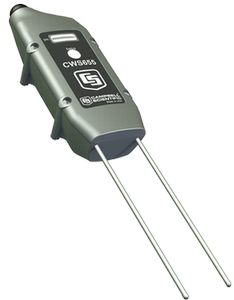
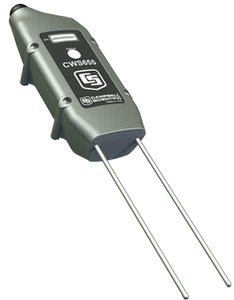
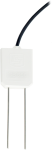
The CWS655 is a wireless version of our CS655 soil water reflectometer. It has 12 cm rods and monitors soil volumetric water content, bulk electrical conductivity, and temperature. This reflectometer has an internal 900 MHz spread-spectrum radio that transmits data to a CWB100 Wireless Base Station or to another wireless sensor. The internal radio's frequency is commonly used in the US and Canada.
続きを読む利点と特徴
- Versatile sensor—measures dielectric permittivity, bulk electrical conductivity (EC), and soil temperature
- Measurement corrected for effects of soil texture and electrical conductivity
- Internal frequency-hopping, spread-spectrum radio provides longer range and less interference
- Battery powered
- A reliable, low-maintenance, low-power method for making measurements in applications where cabled sensors are impractical or otherwise undesirable
- Transmissions can be routed through up to three other wireless sensors
- Compatible with CR800, CR850, CR1000, and CR3000 dataloggers
イメージ
類似製品
詳細
The CWS655 has 12-cm rods that insert into the soil. It measures propagation time, signal attenuation, and temperature. Dielectric permittivity, volumetric water content, and bulk electrical conductivity are then derived from these raw values.
Measured signal attenuation is used to correct for the loss effect on reflection detection and thus propagation time measurement. This allows accurate water content measurements in soils with bulk ≤3.7 dS m-1 without performing a soil-specific calibration.
Soil bulk electrical conductivity is also derived from the attenuation measurement. A thermistor in thermal contact with a probe rod near the epoxy surface measures temperature. Horizontal installation of the sensor provides accurate soil temperature measurement at the same depth as the water content measurement. For other orientations, the temperature measurement will be that of the region near the rod entrance into the epoxy body.
Why Wireless?
There are situations when it is desirable to make measurements in locations where the use of cabled sensors is problematic. Protecting cables by running them through conduit or burying them in trenches is time consuming, labor intensive, and sometimes not possible. Local fire codes may preclude the use of certain types of sensor cabling inside of buildings. In some applications measurements need to be made at distances where long cables decrease the quality of the measurement or are too expensive. There are also times when it is important to increase the number of measurements being made but the data logger does not have enough available channels left for attaching additional sensor cables.
仕様
| Measurements Made | Soil electrical conductivity (EC), relative dielectric permittivity, volumetric water content, soil temperature |
| Water Content Accuracy | ±3% VWC typical in mineral soils, where solution EC ±10 dS/m |
| Required Equipment | CWB100 |
| Rods | Not replaceable |
| Sensors | Not interchangeable |
| Weather Resistance | IP67 rating for sensor and battery pack (Battery pack must be properly installed. Each sensor is leak tested.) |
| Operating Temperature Range | -25° to +50°C |
| Operating Relative Humidity Range | 0 to 100% |
| Power Source | 2 AA batteries with a battery life of 1 year assuming sensor samples taken every 10 minutes. (Optional solar charging available.) |
| Average Current Drain | 300 μA (with 15-minute polling) |
| Rod Diameter | 3.2 mm (0.13 in.) |
| Rod Length | 12 cm (4.7 in.) |
| Dimensions | 14.5 x 6 x 4.5 cm (5.7 x 2.4 x 1.77 in.) |
| Weight | 216 g (7.6 oz) |
Measurement Accuracies |
|
| Volumetric Water Content | ±3% VWC typical in mineral soils that have solution electrical conductivity ≤ 10 dS/m. Uses Topps Equation (m3/m3). |
| Relative Dielectric Permittivity |
|
| Bulk Electrical Conductivity | ±(5% of reading + 0.05 dS/m) |
| Soil Temperature | ±0.5°C |
Internal 25 mW FHSS Radio |
|
| Frequency | 902 to 918 MHz |
| Where Used | US and Canada |
| FHSS Channel | 50 |
| Transmitter Power Output | 25 mW (+14 dBm) |
| Receiver Sensitivity | -110 dBm (0.1% frame error rate) |
| Standby Typical Current Drain | 3 μA |
| Receive Typical Current Drain | 18 mA (full run) |
| Transmit Typical Current Drain | 45 mA |
| Average Operating Current | 15 μA (with 1-second access time) |
| Quality of Service Management | RSSI |
| Additional Features | GFSK modulation, data interleaving, forward error correction, data scrambling, RSSI reporting |
互換性
注意: 以下は代表的な互換性情報を示しています。互換性のある製品や互換性のない製品をすべて網羅したリストではありません。
ダウンロード
Wireless Sensor Planner v.1.7 (30.5 MB) 08-08-2013
The Wireless Sensor Planner is a tool for use with Campbell Scientific wireless sensors. It assists in designing and configuring wireless sensor networks.
よくある質問
CWS655に関するよくある質問の数: 34
すべて展開すべて折りたたむ
-
The bulk electrical conductivity (EC) measurement is made along the sensor rods, and it is an average reading of EC over the top 12 cm of soil.
-
Damage to the CWS655 electronics or rods cannot be repaired because these components are potted in epoxy. A faulty or damaged sensor needs to be replaced. For more information, refer to the Repair and Calibration page.
-
The volumetric water content reading is the average water content over the length of the sensor’s rods.
-
No. The abrupt permittivity change at the interface of air and saturated soil causes a different period average response than would occur with the more gradual permittivity change found when the sensor rods are completely inserted in the soil.
For example, if a CWS655 was inserted halfway into a saturated soil with a volumetric water content of 0.4, the probe would provide a different period average and permittivity reading than if the probe was fully inserted into the same soil when it had a volumetric water content of 0.2.
-
Shortening the rods will void the warranty. There are several other reasons why Campbell Scientific strongly discourages shortening the sensor’s rods. The electronics in the sensor head have been optimized to work with the 12 cm long rods. Shortening these rods will change the period average. Consequently, the equations in the firmware will become invalid and give inaccurate readings.
-
The CWS655 can detect water as far away as 10 cm in saturated sand. As the soil dries down, that distance decreases to approximately 4 cm in dry sand.
-
No. The equation used to determine volumetric water content in the firmware for the CWS655 is the Topp et al. (1980) equation, which works for a wide range of mineral soils but not for organic soils. In organic soils, the standard equations in the firmware will overestimate water content.
When using a CWS655 in organic soil, it is best to perform a soil-specific calibration. For details on performing a soil-specific calibration, refer to “The Water Content Reflectometer Method for Measuring Volumetric Water Content” section in the CS650/CS655 manual. A linear or quadratic equation that relates period average to volumetric water content will work well.
-
Because the reported volumetric water content reading is an average taken along the entire length of the rods, the sensor should be fully inserted into the soil. Otherwise, the reading will be the average of both the air and the soil, which will lead to an underestimation of water content. If the sensor rods are too long to go all the way into the soil, Campbell Scientific recommends inserting the rods at an angle until they are fully covered by soil.
-
Yes, but the pots would have to be large. The CWS655 can detect water as far away as 10 cm (4 in.) from the rods. If the pot has a diameter smaller than 20 cm (8 in.), the CS655 could potentially detect the air around the pot, which would underestimate the water content. In addition, potting soil is typically high in organic matter and clay, causing the probably need for a soil-specific calibration.
-
No. The principle that makes the CWS655 work is that liquid water has a dielectric permittivity of close to 80, while soil solid particles have a dielectric permittivity of approximately 3 to 6. When liquid water freezes, its dielectric permittivity drops to 3.8, essentially making it look like soil particles to the CWS655. A CWS655 installed in soil that freezes would show a rapid decline in its volumetric water content reading with corresponding temperature readings that are below 0°C. As the soil freezes down below the measurement range of the sensor, the water content values would stop changing and remain steady for as long as the soil remains frozen.
記事とプレスリリース
Privacy Policy Update
We've updated our privacy policy. 詳細はこちら
Cookie Consent
Update your cookie preferences. クッキーの設定を更新する